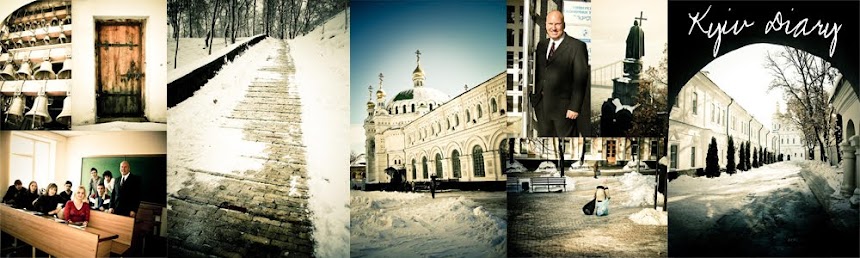
Showing posts with label Soviet Union. Show all posts

Friday, March 12, 2010

The Rebirth of St. Michael's of the Golden Domes


Yesterday I bought a large book of historical photographs (mostly nineteenth century) of Kyiv. Included are several shots of the monastery of St. Michael of the Golden Domes, which is less than 100 paces from my apartment. Reading about these historical photographs as well as reading my new book about the Cathedral of St. Volodymyr, which I wrote about yesterday, the long tragic and ultimately triumphant story of St. Michaels has become clear in my mind.

Pictured above is the front of the main Cathedral from the base of the belltower. Pictured below is the rear of the Cathedral with the smaller refectory chapel of St. John the Theologian on the left. The entire monastery is enclosed within high walls. There is also a magnificent bell tower fronting on the public square. This gives the reader some sense of the layout of the complex.

The monastery was founded in about 1050 A.D. and the original church, on the site of the present Cathedral, was built after 1100. This original church was reportedly the first church in Kyiv to have gilded domes--hence the name "St. Michael of the Golden Domes." The monastery became a magnet for generations of pilgrims, chiefly because the relics of St. Barbara were housed here. In my new book I have a nineteenth century picture of thousands of pilgrims climbing the steep hillsides in long lines beneath the statue of St. Volodymyr and on up to St. Michaels. St. Barbara's relics were brought to Kyiv from Constantinople in 1108 by the wife of Sviatapolk Iziaslavych's wife in a silver reliquary. As I wrote yesterday, during the Soviet era, these relics were removed to St. Volodymyr's Cathedral, where they remain to this day.

(Incidentally, I had an interesting experience yesterday during the hour or so I stood alone in St. Volodymyr's near St. Barbara's relics. They are now preserved in a sarcophagus-like container housed beneath a magnificent golden canopy with marble steps. I saw several people walk up the steps to view the relics, so I thought--why not. I went up the steps for a brief view. As I quietly walked back down the steps I was accosted by a most officious gentleman who asked me (in Russian) if I was a Christian. "Yes," I said. "Then why don't you make the sign of the cross? You must always make the sign of the cross as you approach or walk away from sacred things!" He was not pleased with me. I, of course, did not want to be disrespectful, but did not heed his demands that I make the sign of the cross--I could only think of Daniel and his companions who refused to pray as directed by Nebuchanezzar when they heard the sound of "the cornet, flute, harp, sackbut, dulcimer and all kinds of music.")

The Golden Domes were pulled down and the Cathedral destroyed by the Soviet's in about 1936, and a new administrative complex for the Ukrainian S.S.R. was built on the ruins. Apparently there were tennis and volleyball courts on the actual site of the Cathedral. The monastic buildings just north of the Cathedral were apparently party offices--my friend Wilfried Voge told me that his wife remembers attending social events there as a child. After the collapse of the Soviet Union the Cathedral was rebuilt on the ancient site.

The little chapel dedicated to St. John the Theologian, which was built in 1713, is the original structure and survived the Soviet desecration of the monastery. It was used as a locker room for the Soviet sports complex on the site during the dark years of Soviet rule.

There is, of course, a lesson in all of this--that nothing is irrevocably lost. The new Cathedral is now the centerpiece of a thriving, vibrant and joyful monastery, which has apparently become the training seminary for many of the nations Ukrainian Orthodox priests. Although not an ancient structure, the new Cathedral is most beautiful inside.

Monday, March 8, 2010

A Very Cold Monday


I ventured out a few times today, for my morning run, to visit St. Michaels, to shop for groceries, and later to browse along Andriysky Spusk.

It was bitterly cold all day, although the sun did come out now and then. I ran only about three miles, all in the Volodymrska Hill Park district of the city. On laps behind St. Michaels and past the Funicular, I was intrigued to watch an old man feeding the little birds out of his hand. He would stand very still with his palm upturned, and the birds would hover over his hand to eat bread crumbs. There were also many parents or grandparents out with little children in sleds.

I had a nice conversation with a woman in the refectory shop at St. Michaels, and bought a nice book on ikons.

In the afternoon I went to Andriysky Spusk, which is a sort of tourist trap in Kyiv, and browsed in the many outdoor art and souvenir booths. I was bare-headed and a woman came up to me and remonstrated that I needed a hat--actually I think she was trying to sell me one. I looked at a few navy and army caps with either Soviet or Ukrainian insignias, and wondered about their authenticity (or lack thereof). I didn't buy anything but did get a nice picture of some intricately wrought gates with (I'm sure) genuine Soviet insignias. These were behind the ministry building next door to St. Michaels.

St. Andrew's rises dramatically from the street, with dramatic gold trimmed blue domes. I love the dramatic exterior of St. Andrews, but it has a more ostentacious feeling inside than other Orthodox Churches--less worshipful, perhaps, more for show than for worship. I know people like that--they look very impressive, but somehow leave you cold when you take a look inside, as it were.

I returned home in mid afternoon to finish some laundry, to do a little grocery shopping and to pack for my evening train ride to Kharkiv.

Tuesday, November 20, 2007

The "Golden Gate" in an "Iron Curtain"


Right outside the exit doors of the Zoloti Voroda Metro station is the monument which gives the place its name, the "zoloti Vorota" or Golden Gate of the city of Kiev. The history of this gate is emblematic of the long and often troubling relationship between Russia and Ukraine. This is, indeed the site of a very ancient gate to the City of Kyiv, constructed by Yaroslav the Wise in the eleventh century. Historical records show that the gate was used for many centuries, although by 1750 the gates were in ruins and partially covered with earth. In the nineteenth century the earth was scraped away from the ancient foundations of the gate so they could be seen, and this was the state of affairs until the 1982 construction of the monument depicted here. In 1982 there was a celebration of the 1,500th anniversary of the founding of Kyiv, and at that time the Soviet Union commissioned architects and archaeologists to construct a new gate upon the original site. The problem is that the new "reconstruction" is built upon the ancient one, thus essentially destroying the archaeological site. There are also many questions about the accuracy of the Soviet reconstruction. Upon inspecting the new "Golden Gate," I found it telling that there are placards commemorating the event in both Russian and Ukrainian. On the south side of the monument are huge doors, and on the north side a sliding spiked grate with timber latticework.
In contemplating the presence of this monstrosity, it occurs to me that the intent behind the Soviet reconstruction was to coopt Ukrainian history and place it within the ambit of the Russian-dominated Soviet Union. In other words, the Soviet gate it is not a gate which "opens" but a gate which only "closes." It closes freedom, inquiry and even history for the Ukrainians. This was literally the "Golden Gate" in the "Iron Curtain." Thus, I find it poignant that the "Golden Gate" was locked when I inspected it.
Now that the "Iron Curtain" has been breached, the doors of the "Golden Gate" are swinging open for Ukraine and all of the other oppressed nations of eastern Europe. May the doors of the "Golden Gate" never again be locked!

Friday, November 16, 2007

The Monument to the Baptizer


The Monument to Prince Volodymyr the Great has drawn me for many reasons. It is, after all, one of the most recognizable images of Kyiv, standing stark, with an almost medieaval fierceness about it, over the broad waters of the Dnipro. It is also a kind of sole survivor--I understand it is the largest religious symbol left untouched by the Soviet authorities over seven decades of anti-religious rule. It is also a great Christian symbol, it having been erected in 1853 to commemorate the first Christian baptisms in the Dnipro river below this spot in the year 988 after Prince Volodymyr had himself converted. This event is depicted on the face of the statue in a bas-relief entitled, "Baptism of the Rus." Finally, the Southeast corner of this monument is the site of a special prayer uttered over the nation of Ukraine and the people of Kyiv by Boyd K. Packer on September 12, 1991. For these, and other reasons, this place is very special to me.

The Winter Birds


This morning as I was walking along the ornamental iron railing at the edge of the Volodymyrs'ka Hill Park, I noticed that someone had built a small homemade bird feeder and hung it in the branches of one of the overhanging trees. I decided to take a picture, but by the time I had lifted my camera three or four little yellow breasted birds with black and white faces flew into my view and landed near the feeder. I watched with delight for several minutes as they flew in and out the feeder.


A couple of impressions struck me as I watched these little birds. First, I like the idea that there is some soul in Kyiv who has taken private delight in building this little feeder and in coming regularly to put seed or suet under its little roof for the small birds of the woods. I can picture this person, perhaps an older man or woman, who makes his or her daily pilgrimage up the hill with food to replenish the dimished stock. Then perhaps this person sits on one of the long park benches facing the railing and watches for the little vagabonds of the air to come for dinner. This unknown bird lover is emblematic of many people I have known in my life, who take private delight in blessing the lives of others. Such persons usually act anonymously and without fanfare. They are outwardly and not inwardly directed. You wouldn't always recognize them on the street, but in their pockets they carry the inexhaustible sustenance that they love to share with those with deep hunger.


Second, it also occurs to me that these little birds flitting about this humble little feeding station are symbolic of the people of Ukraine itself--a people who have endured a long winter of adversity and oppression and tyranny. And now, though the snows may still partially cover the ground, the beautiful birds are still alive and joyful and vibrant, needing only the food of democratic freedom to thrive in their hilltop paradise. In this sense, I am bringing a few kernels of seed to the feeder. May the bright colored birds survive and thrive to enjoy the glorious return of a new Spring.

Wednesday, November 14, 2007

The Literature Police in the Universityet Metro Station


This morning as I was passing through the Universityet Metro station, I noticed for the first time the beautiful and ornate artwork of this station. Most of the Metro stations are like underground public cathedrals, built during the Soviet era as kind of monuments to the state. Each station has a different motif and style. The Universityet station, I now see, has a literary theme in keeping with its name and proximity to the Taras Schevchenko University and other schools in the district. I was fascinated by a series of a dozen or more large busts which flank the two walls of the central underground chamber, and so I got out my digital camera and started taking pictures. An officer in a blue uniform with an officious little cap came running up to me, shouting for me to stop taking pictures. He didn't explain what the great harm would be in taking pictures of the busts of Pushkin and Tolstoy and other Russian writers, and I didn't ask him. I suppose that the stifling totalitarian mindset of seventy years of communist tyranny are hard to shake off. I only wish I had been able to take a picture of the little minion who reprimanded me.

Tuesday, November 13, 2007

Teaching at the Національний авіаційний Університет


This evening I taught at the Національний авіаційний Університет (the National Aviation University) which is located on Kosmonavta Komarova Ave. in Kyiv. This is one of the largest Universities in Ukraine, with a student population of over 35,000. The name of the street, "Kosmonavta Komarova" is significant, because this is one of the former training schools for Russian cosmonauts and pilots, as well as all of the supporting personell to the Soviet air corps. Today, it still has a military training function, but it has become a true public University, with many graduate programs, including a highly-thought of law school. The law school was created, along with dozens of others, in the wake of indepence in the 1990's.
This class was very small and somewhat lethargic at first, probably due to the evening hour. There are a couple of very sharp young ladies in the class. The young men seemed a little out of it, sitting together on the back row. I also wondered if the English language capability of this group was not as high as some of the other groups. Notwithstanding that, we had a good session, and I hope to have some good presentations from them on Thursday.


Eating in "the Lunchroom of the Cosmonauts"


Following my lecture at Kiev International University, Olga and I walked some distance from campus through the snow and caught a private bus to take us to the campus of the National Aviation University, which is very far from any Metro Station, and is thus the most difficult to get to of any of the five schools. The small bus was extremely crowded, with single seats down each side, packed with people, and at least twenty others standing in the narrow aisle, like pop cans in a vending machine. Since Olga and I entered the bus at the back door and there was no chance of working our way up to pay the driver, we sent the fare (one and a half hryvnia) up to the driver with the other passengers, who conveyed it hand over hand all the way to the front. I soon saw that this was de rigueur, and as other passengers entered and sent their money up, I saw that the driver would even send coins or bills back as change. Later in the evening, as we returned part way home on a similar bus, I marveled at the multi-tasking skill of the man, negotiating horrendous traffic, while also making exact change.
At the National Aviation University, we went to a large lunchroom where we ate and visited for an hour or so, while waiting for our next class. The National Aviation University is a very large school, with a student body of about 35,000. Under the former Soviet Union it was one of the chief training schools for pilots, members of the air force and for the Soviet space program. Thus, my very tasty lunch (Chicken Kiev, bread, with both mashed potatoes and rice) was partaken in the lunchroom of the cosmonauts. Seated around us were many University students wearing uniforms with wings. Olga explained to me that when the Soviet Union fell there was a great dearth of attorneys and law schools. It was in the early days of independence that a law school was formed here, as well as in many other major Ukrainian Universities. Thus, the need for lawyers and the schools to train them is a necessity (or, as ill-informed critics would say, a curse) of a free and democratic society. Notwithstanding all of the jokes and horror stories, without lawyers to stand up for the little man, there could be no true access to the courts and the constitutional protections they afford.
Over lunch, Olga and I also continued a most interesting discussion about the history of the Ukrainian Orthodox Church, its relationship to the Russian Orthodox Church, and the history of political manipulation and suppression of the various churches by the Soviet authorities. Olga has agreed to accompany me to a Ukrainian Orthodox mass in St. Michael's on Sunday morning, which I am looking forward to with great anticipation and joy. Olga also agreed to accompany me to the ballet on Friday evening (provided we can obtain tickets), and she gave me a gift today of a beautiful presentation book on Kyiv. She is a most excellent guide, confidant and "handler of American Judges."

Monday, November 12, 2007

Teaching at the Київський нацiональний економiчний унiверситет

This evening was my first session at the Київський нацiональний економiчний нiверситет (the Vadym Hetman Kyiv National Economic University), which is a University with a daytime student population of over 20,000, including a full law school founded fifteen years ago, shortly after Ukraine's independence from the former Soviet Union. I met Olga at the Shulyavska Metro station, where I had never been before, which is right next to the very large campus, and walked together to the law school building.

I lectured tonight in the mock trial room, complete with a throne-like bench, jury box, counsel tables, podium and a gallery with the kind of slant-topped desks you might see in the Scriptorium of some mediaeval monastery. My lecture went very well. The class was very bright and very responsive. I have heard reports from the other judges that this is the most promising class we have, and I can't disagree with this assessment at this point.


I have been trying to throw in a few Russian proverbs, and jokes, etc., and the class has seemed very responsive. The assistant law professor who attended thought that the lecture was well received.


I have been trying to emphasize to my classes that the skills for successful advocacy have nothing to do with looks, age, gender, or outward appearances of wealth or good taste, such as in the manner of dress. What really matters for the great advocate is the ability to connect on a human level with the jury. Some of the greatest trial attorneys I have seen in action fall into this category--their success is a mere reflection of their overflowing humanity. The Hollywood image of the successful, wealthy and arrogant attorney is an utter fiction. What matters is the ability to communicate with sincerity and compassion and openness to the jury.

Saturday, November 10, 2007

Navigating the Metro

It is now about 5:30 p.m. I had a wonderful day. I first decided that I needed to learn how to use the Metro system. I purchased a couple of little green plastic tokens at a cashier's station (they cost 50 kopiykas each, or half a griven). I deposited my token in the turnstile, then followed a vast throng of people and we descended into the entrance at Lva Tolstovo. Here you descend into a long escalator, perhaps several hundred feet long, into a cathedral like space with archways opening onto parallel tracks, one on each side. I noted that some of the ornate grillwork bore the year, "1960," so I am assuming that is when it was built or refurbished. There is also, embossed in the brick and cement work, colored signs showing the direction of travel, all of the succeeding stops, as well as connections down the line. The trains come rushing in every few minutes, pause probably twenty seconds, and then hurtle off down the tunnel. After observing the procedure for a few minutes, I ventured into the subway car headed for the Maidan station. There I disembarked, and found the connecting tunnel which leads to the sister station, Chreschatik, which is on a different line.

The connecting tunnel is amazing. It has a high arched ceiling, and the whole thing gradually rises, then falls again to the other station. The connecting tunnel must be considerably longer than a football field. It was here that I met my new friend, Valery, playing his accordian for passing change.

At Chreschatik, I again observed and studied the signs, then boarded an east bound train for Arsenalna, a station further east. It was here that I hoped to begin a walk down the Dnieper River to Pecherska Lavra. When I got to the surface, however, I found that it was now raining steadily. I paused in the square at Arsenalna long enough to watch a plainly dressed woman, wielding a very old-fashioned looking broom, sweeping a spot for her to display her fresh flowers. I also inspected the Arsenalna statue, which is a war memorial, noting both the remaining sickle and hammer imagery of the former Soviet Union, as well as the poignant flowers and bouquets recently laid there.

Deciding to go to Pecherska Lavra another day, I again descended into the Metro at Arsenalna. Here the depth of the train platform is amazing. There two very long escalators leading down, each of which was easily 3-400 feet.

I left the Metro at Chreschatik, and decided to look for "Arena City," where I understood a somewhat Western-like grocery store exists. I had in hand the handwritten notes from the family of one of the other judge instructors, giving directions. Their teenage daughter wrote the notes out and, not knowing any Russian or Ukrainian, had drawn a very nice picture of the Cyrillic words "Мандарин Плаза" ("Mandarin Plaza")and logo on the grocery store door. I soon became lost trying to navigate the streets of downtown Kyiv, but in my travels, I recognized the logo and words written by the judge's daughter, and so decided to buy groceries. I purchased a couple of loaves of bread, some butter, honey, milk, orange drink, cheese, oranges and cold cereal. Upon leaving Mandarin Plaza, I asked a uniformed security guard how to get to the Lva Tolstovo Metro stop. He told me that it was only one street away and showed me the direction. I was quite proud of myself for being able to converse enough to find my way. Incidentally, I must not look like a total American idiot here, because in my travels I had two different people stop me to ask for directions.

Thursday, November 8, 2007

Armchair Traveler


This morning I awoke at about 4:30, very excited and anxious to be underway. After showering, shaving, dressing and putting the last few items in my luggage, I paused for a few moments in my upstairs study, where I have spent so many hours reading, studying, pondering this world, its literature and my place in it. Up to now I have been an armchair traveler only, never venturing beyond the safe cocoon of my little insular world. My daily routine has carried me, as it were, only between the safe poles of my leather reading chair and the comfortable environs of my judicial bench and chambers.

I have been reading and thinking about eastern Europe, and particularly the former Soviet Union for thirty years. Now is the time to venture forth from my secure niche and see it for myself firsthand, and even attempt to give some service there which will be of benefit to those who live there. My teaching of the great democratic bulwark of the jury trial to a new generation of lawyers may the first step in that service. My hope is that all of the years of pondering, reading, studying and musing over the subject and the people may be fruitful in my first venture beyond the leather chair in my study.