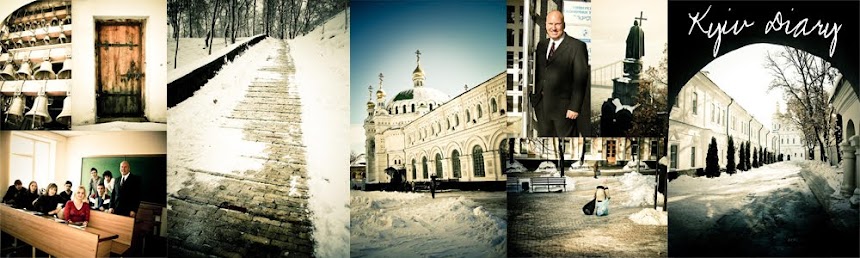
I have always been fascinated by the boundaries of things, the margins, where vast changes in society are the most evident. It is at the boundaries where real change occurs, where the first harbingers of future societal shifts are first evident, and where the lingering remnants of the past hold on tenaciously. In my first forty-eight hours in Ukraine I have already seen the moving frontiers of change. Some examples:
Political Boundaries: In the Taras Schevshenko Park I saw an old man i n full Soviet army regalia, walking through the swarms of pigeons, his hands thrust in the pockets of his greatcoat, deeply absorbed in thought. Elsewhere I have seen other trappings and memories of the recent grip of the Soviet Union on this land. This is a city with the deep imprint of the Communist past still etched on its face. Most of the buildings (including the one where I now live) are of Soviet vintage, although there appears to be a massive construction boom underway. And I suppose the nostalgia and longing for a simpler time may run deep in many hearts. In every newstand where I have browsed the Ukrainian and Russian-speaking press is filled with stories about the recent elections, and the continuing growing pains of this young democracy. I suppose that the teaching which I will present in the coming weeks is a part of those growing pains. The Constitution of Ukraine provides for the right to a trial by a jury of one's peers in a criminal case, and yet there has not been a single jury trial in Ukr
 aine since independence.
Economic Boundaries: The chasm between rich and poor is stunning. It is seen on the streets every day, with women in chic and expensive clothing, stooping in their high heels to drop a few coins onto the knapsack of an itinerant street performer. Yesterday I took a picture of an old Soviet-era car parked on a downtown street, then as I turned I saw that the car was parked directly in front of the display window for a new Porshce 911. My driver on Friday boasted (or lamented) that 9 0% of the wealth of the nation is controlled by less than 5% of the people, who were smart enough, or unscrupulous enough, to seize control of it after the fall of Communism, and that the vast majority of the population live in very modest circumstances.
Language Boundaries: It is a source of endless fascination how this City apparently operates with two parallel languages--Russian and Ukrainian. I understand that the eastern, heavily populated region of Ukraine is predominantly Russian speaking, that the west half, and the rural areas are predominantly Ukrainian speaking. Here it is a very confusing mixture. It is especially bewildering for someone like me, with a moderate  understanding of Russian, because the printed or spoken word all around me may be from moment to moment, Russian, Ukrainian or some bizarre mixture of the two. For example, today I attended Church in the little Mormon Ward in downtown Kyiv. The Church sign in the lobby was in Ukrainain, the church hymns in the Sacrament Meeting were sung in Ukrainian by the entire congregation, the speakers from the pulpit were about half Ukrainian and half Russian speaking, and in a scripture class which I attended, the teacher, who had books for class members would ask, "Do you want Russian or Ukrainian?" I can imagine that even greater changes in language may be in store in future generations, especially should Ukraine continue its definite trajectory away from the Russian influence and toward the European.
Religious Boundaries: There appears to me to be a deep piety and spirituality about most of the Ukrainians I have met. You could almost feel this tangibly as I walked the streets of the City from Friday night to Sunday morning. The City is very vibrant and alive, and yet on Sunday there is a marked change in the posture, attitude and even conversation of the people which I attribute to a deep religiosity in t he hearts of most of the people. I have not yet had a chance to make my pilgrimages to the great Orthodox sites in the City, but I did attend, as I have said, the small religious services of the tiny Mormon congregation here. There I was the only Westerner present except for some young missionaries from Europe or North America). The Mormon congregation is lead by a Bishop, who is native Ukrainian and who joined his new religion within the past ten years. This is true of the entire congregation, and I was amazed to see not only young families, but many single men and women in their early twenties, many teenagers, and most surprisingly, a good number of older men and women of perhaps sixty, seventy or eighty years of
  age.
age.