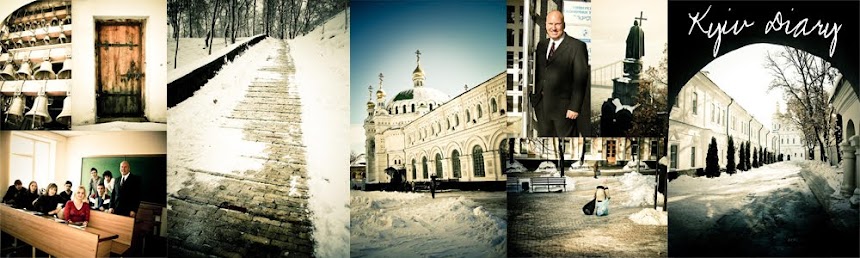
Showing posts with label Former Soviet Union. Show all posts

Monday, November 12, 2007

Lunch with a Saint


After teaching at the Academy in the morning and having "tea" with the faculty at the law school, I was invited to share lunch with Olga in her book-crammed apartment in the very ecclectic and fascinating neighborhood in the vicinity of Zoloti Vorota and Volodymrska. She cooked me food which she had planted and harvested on her own land on the opposite side of the Dnipro River. We had a marvelous hot borscht, seasoned cauliflower stalks and parsley salad with braised veal. It tasted so good on a snowy day, especially knowing that the hands that cooked it had also planted and nurtured it on the land. The antique clock from her old family home ticked away above us as we ate and visited. Over lunch Olga told me much of her family and her fascinating life, dating back to the horrendous days of the German occupation of World War II, and through her family's deep Orthodox piety during the repressive times of the Soviet Union. Much of what she shared with with me is too sacred and personal to express in this setting, but she has had experiences of deep import, which I have recorded in my personal diary. As I took leave of her I had the impression that here is a true Saint if there ever was one.

Sunday, November 11, 2007

The Shifting Boundaries


I have always been fascinated by the boundaries of things, the margins, where vast changes in society are the most evident. It is at the boundaries where real change occurs, where the first harbingers of future societal shifts are first evident, and where the lingering remnants of the past hold on tenaciously. In my first forty-eight hours in Ukraine I have already seen the moving frontiers of change. Some examples:


Political Boundaries: In the Taras Schevshenko Park I saw an old man in full Soviet army regalia, walking through the swarms of pigeons, his hands thrust in the pockets of his greatcoat, deeply absorbed in thought. Elsewhere I have seen other trappings and memories of the recent grip of the Soviet Union on this land. This is a city with the deep imprint of the Communist past still etched on its face. Most of the buildings (including the one where I now live) are of Soviet vintage, although there appears to be a massive construction boom underway. And I suppose the nostalgia and longing for a simpler time may run deep in many hearts. In every newstand where I have browsed the Ukrainian and Russian-speaking press is filled with stories about the recent elections, and the continuing growing pains of this young democracy. I suppose that the teaching which I will present in the coming weeks is a part of those growing pains. The Constitution of Ukraine provides for the right to a trial by a jury of one's peers in a criminal case, and yet there has not been a single jury trial in Ukraine since independence.

Economic Boundaries: The chasm between rich and poor is stunning. It is seen on the streets every day, with women in chic and expensive clothing, stooping in their high heels to drop a few coins onto the knapsack of an itinerant street performer. Yesterday I took a picture of an old Soviet-era car parked on a downtown street, then as I turned I saw that the car was parked directly in front of the display window for a new Porshce 911. My driver on Friday boasted (or lamented) that 90% of the wealth of the nation is controlled by less than 5% of the people, who were smart enough, or unscrupulous enough, to seize control of it after the fall of Communism, and that the vast majority of the population live in very modest circumstances.

Language Boundaries: It is a source of endless fascination how this City apparently operates with two parallel languages--Russian and Ukrainian. I understand that the eastern, heavily populated region of Ukraine is predominantly Russian speaking, that the west half, and the rural areas are predominantly Ukrainian speaking. Here it is a very confusing mixture. It is especially bewildering for someone like me, with a moderate understanding of Russian, because the printed or spoken word all around me may be from moment to moment, Russian, Ukrainian or some bizarre mixture of the two. For example, today I attended Church in the little Mormon Ward in downtown Kyiv. The Church sign in the lobby was in Ukrainain, the church hymns in the Sacrament Meeting were sung in Ukrainian by the entire congregation, the speakers from the pulpit were about half Ukrainian and half Russian speaking, and in a scripture class which I attended, the teacher, who had books for class members would ask, "Do you want Russian or Ukrainian?" I can imagine that even greater changes in language may be in store in future generations, especially should Ukraine continue its definite trajectory away from the Russian influence and toward the European.

Religious Boundaries: There appears to me to be a deep piety and spirituality about most of the Ukrainians I have met. You could almost feel this tangibly as I walked the streets of the City from Friday night to Sunday morning. The City is very vibrant and alive, and yet on Sunday there is a marked change in the posture, attitude and even conversation of the people which I attribute to a deep religiosity in the hearts of most of the people. I have not yet had a chance to make my pilgrimages to the great Orthodox sites in the City, but I did attend, as I have said, the small religious services of the tiny Mormon congregation here. There I was the only Westerner present except for some young missionaries from Europe or North America). The Mormon congregation is lead by a Bishop, who is native Ukrainian and who joined his new religion within the past ten years. This is true of the entire congregation, and I was amazed to see not only young families, but many single men and women in their early twenties, many teenagers, and most surprisingly, a good number of older men and women of perhaps sixty, seventy or eighty years of age.

Inside Krasnoarmeyskaya 23A


The apartment on Krasnoarmeyskaya 23A (sometimes also called Lva Tolstovo Plazha by some locals) is a four story apartment building. The apartment, No. 33, is on the top floor and includes a living room, bedroom, bathroom, separate toilet, and kitchen. The ceilings are high and very ornate. I don't know how old the building is--I think I first presumed an age of 75 to a hundred years. However, today I noticed that some workman had laid year numbers in small stone fragments set in cement on one of the landings--1961 if I remember correctly. So this may just be a Soviet-era apartment building of fairly recent vintage.


Here are the pros and cons of this apartment.


I'll give the bad news first. Ironically, my main difficulty with the apartment is the temperature. Who would have thought, given that it is below freezing outside. It is so hot, with the heat waves just rolling off of those Soviet-era radiators into the room. Even with the high ceilings, it is very hot. I have slept very well without any covers since my arrival, and a few times I have arisen in the night to step out onto the balcony for a few minutes or to open a window briefly to cool down. For example, as I have been sitting here in the living room writing this, I have opened the window twice, even though it has been snowing outside, to cool the room down a little.


The good news. The location of this apartment is amazing. It overlooks one of the main subway stations, with fast connections to virtually any point in the city. It is also close to shopping, sightseeing, etc.


Enjoy the house tour!

Saturday, November 10, 2007

First Impressions of the Grand City on Foot

I have just returned from a three and a half hour foray into this great city. Here are some random first impressions:

It is bitterly cold this weekend. I slept very well during the night without any covers, due in large part to the high BTU output of the Soviet-Union-Era steam heating system in the building (complete with Soviet-Union-Era paint in many layers preventing one from turning off the unit or turning it down). Indeed, the apartment has been so cozy that from time to time I have opened a window to let in a little cool air. Thus, when I left the apartment this morning, I was unprepared for the bitter cold.

I walked first up to Taras Schevshenko Park. There were many people walking their amazingly well behaved little dogs on the east side of the park. On the south side, in a little walled off plaza are a multitude of stone benches and tables. Under a gazebo was a lone man with a chess board, I suppose waiting for his opponent for a chilly match. There were others in the park, including two or three women sitting on benches, and an old man in an ornate military uniform with braided cap, walking, absorbed deep in thought. In he center of the park is a soaring bronze statute of the writer, Taras Schevshenko.


      Walking in the immediate neighborhood of the apartment, I was struck by the vibrant commercial and entreprenuerial spirit in this city. Everywhere people are doing business--in storefront shops, in basement restaurants and pubs, in kiosks on the street, on makeshift platforms at curbside, on the street itself or on the sidewalk. Everywhere people are selling, advertising, doing business. Flowers are for sale at the corner, vegetables under a green awning. And everwhere the advertisements are pervasive, emblazoned in streaming banners from tall buildings, neon lights atop steel frames, on temporary billboard signs, and in hand-scrawled or printed fliers. These are pasted on telephone poles in such thick layers, that the original metal or wood is long obscured, buried under the alluvium of commerce.


              I next ventured for the first time into the underground world of Kyiv. My head is still swimming. There is an entire subterrean world in this city, and, at least in this weather, the underground city is more massive and vibrant, if possible, than the one at street level. At the corner of nearly every major intersection there is a staircase leading underground, and underneath the intersection is a kind of mall lined with little shops, or by people hawking things from tables or platforms. It is also warm and dry below ground, and the snaking and twisting corridors were full of people. At intersections boasting a Metro station, the below ground commercial world is more ornate, tony and upscale, as these passageways are also connected to the vast Metro or subway system of the city. Much more about the Metro in a later post.

              After a few hours of exploration, I found the grocery store in Mandarin Plaza and returned home for a bite of lunch and a rest. More later.


              Friday, November 9, 2007

              Travels with Yuri


              After I breezed through customs, I passed up a nondescript staircase and hallway into a large lobby packed with people thronging a long roped off walkway, waiting for friends or family to get through customs. I ran the gamut of several hundred people, and presently saw a pleasant looking and very slender man in a leather jacket holding up a sign which read, "Dan Gibbons."

              He introduced himself as Yuri Dregolas, (it rhymes with "Legolas," and actually now that I think about it, he kind of looks like a Russian battle elf) and lead me to his late model five speed car in which he drove me the twenty or thirty kilometers into downtown Kyiv, all the while keeping up a cheerful chatter in very good English. He is the son of a scientist, and attended an advanced English speaking school from a very young age, being trained to be a translator. He now works frequently for the property manager from whom the Institute has rented our apartment. On the card he left me, he wrote, "Taxi Driver."

              The traffic in Kyiv is OUT OF CONTROL. The flow from the airport was easily 130 to 140 kilometers per hour. In town the traffic was horrendous, and most remarkable by the apparent disregard of all traffic regulations by all drivers. Constant merging, tailgating, driving on the wrong side of the road, driving up and over curbs, driving on sidewalks. But everyone seemed pleasant and amazingly courteous.


              On the way into town Yuri played the accomodating tour guide, commenting on Soviet era cars and brand new Lexuses, on the landscape, on the tax laws, on the recent elections, and on the wide variety of buildings. He pointed with especial pride at the "skyscrapers" under construction.

              Kyiv is much larger and busier than I ever imagined. Having lived in Europe during my mission, its older neighborhood have a strong European feeling, but there is also a dilapidated, Soviet style decreptitude about other neighborhoods that is very striking. The people appear to be very attractive, happy and positive.


              Yuri took me right to our apartment, and upstairs, where we met a girl who had just finished cleaning. (More about the apartment later). I have already arranged for Yuri to drive me back to the airport on November 24th.
              From the balcony of the apartment I can see Leo Tolstoy square, one of the main traffic intersections of the city. There is a large, and beautifully renovated building directly across the street, the bottom two floors of which house a glassed-in McDonalds. In front of this building I count this evening easily 40 cars parked on the sidewalk, and there has been a constant din of honking horns (not annoying, but rather oddly pleasant--like Gershwin's "An American in Paris," Annie) all evening.

              Vienna to Kyiv


              From the time I deboarded the Delta flight from Atlanta in Vienna, I had only about 40 minutes to check in to Austrian Airways, race through the Austrian passport check, and then almost run all the way to the other side of the airport for my flight to Kyiv. As it was, I was about the last one to arrive.


              The flight was very interesting, with announcements made by the flight crew in German, Russian and English. Also, they passed out newspapers in both German and Ukrainian. The flight was short, only about 90 minutes, and much of that was spent filling out the Ukrainian "Immigration Card." As we broke the cloud cover and saw the countryside around the airport for the first time, it really struck me that we were here. I have dreamed of this day for thirty years.


              The Kyiv Airport is an older building with a very institutional Soviet-era feeling about it. There is no extending gate which would enable the passengers to walk right into the concourse. Instead, we had to walk down an open stairway some considerable distance out on the tarmac (at least two football fields away from the building), and then board a bus without seats (only overhead and side rails to hold onto) in which we were driven to the concourse. We then enter the building past some sinister looking guys in leather coats and radios through a staircase entrance, and go through a maze of passport and customs stations, all manned by uniformed guards. Before customs, there are carousels where the luggage is being disgorged from the arriving plane. I waited for about fifteen minutes, when a woman in a red uniform walked through the throng calling, "Gibbons, Gibbons!" It turns out she was from the airline, and had learned that my suitcase did not make it to the plane in Vienna (unlike me) but would come later tonight. She then rapidly filled out three or four forms, had me sign them and literally walked me through customs, without the slightest by-your-leave from the uniformed guard there. So, I got through customs in about thirty seconds. That may be why I look so happy in this picture taken in front of the airport by my driver. (More about that later). I had been dreading customs more than anything, and it was over like that.

              The down side is that I will have to stay awake tonight until ten o'clock or later waiting for my suitcase.

              Now I am especially glad that I carried on all of my clothes. I do worry, however, that my incentive gifts for my students will be lost somewhere in central or eastern Europe.