Showing posts with label Church of St. John the Theologian. Show all posts

Friday, March 12, 2010

The Rebirth of St. Michael's of the Golden Domes


Yesterday I bought a large book of historical photographs (mostly nineteenth century) of Kyiv. Included are several shots of the monastery of St. Michael of the Golden Domes, which is less than 100 paces from my apartment. Reading about these historical photographs as well as reading my new book about the Cathedral of St. Volodymyr, which I wrote about yesterday, the long tragic and ultimately triumphant story of St. Michaels has become clear in my mind.

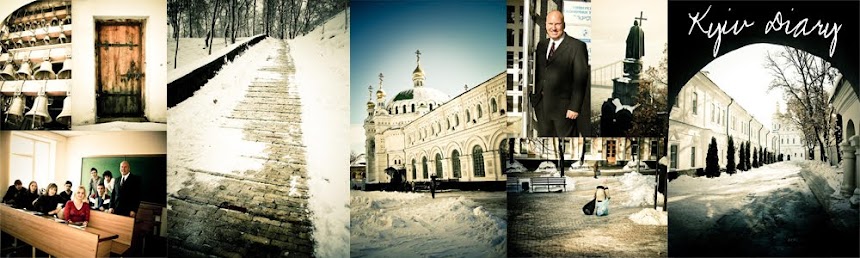
Pictured above is the front of the main Cathedral from the base of the belltower. Pictured below is the rear of the Cathedral with the smaller refectory chapel of St. John the Theologian on the left. The entire monastery is enclosed within high walls. There is also a magnificent bell tower fronting on the public square. This gives the reader some sense of the layout of the complex.

The monastery was founded in about 1050 A.D. and the original church, on the site of the present Cathedral, was built after 1100. This original church was reportedly the first church in Kyiv to have gilded domes--hence the name "St. Michael of the Golden Domes." The monastery became a magnet for generations of pilgrims, chiefly because the relics of St. Barbara were housed here. In my new book I have a nineteenth century picture of thousands of pilgrims climbing the steep hillsides in long lines beneath the statue of St. Volodymyr and on up to St. Michaels. St. Barbara's relics were brought to Kyiv from Constantinople in 1108 by the wife of Sviatapolk Iziaslavych's wife in a silver reliquary. As I wrote yesterday, during the Soviet era, these relics were removed to St. Volodymyr's Cathedral, where they remain to this day.

(Incidentally, I had an interesting experience yesterday during the hour or so I stood alone in St. Volodymyr's near St. Barbara's relics. They are now preserved in a sarcophagus-like container housed beneath a magnificent golden canopy with marble steps. I saw several people walk up the steps to view the relics, so I thought--why not. I went up the steps for a brief view. As I quietly walked back down the steps I was accosted by a most officious gentleman who asked me (in Russian) if I was a Christian. "Yes," I said. "Then why don't you make the sign of the cross? You must always make the sign of the cross as you approach or walk away from sacred things!" He was not pleased with me. I, of course, did not want to be disrespectful, but did not heed his demands that I make the sign of the cross--I could only think of Daniel and his companions who refused to pray as directed by Nebuchanezzar when they heard the sound of "the cornet, flute, harp, sackbut, dulcimer and all kinds of music.")

The Golden Domes were pulled down and the Cathedral destroyed by the Soviet's in about 1936, and a new administrative complex for the Ukrainian S.S.R. was built on the ruins. Apparently there were tennis and volleyball courts on the actual site of the Cathedral. The monastic buildings just north of the Cathedral were apparently party offices--my friend Wilfried Voge told me that his wife remembers attending social events there as a child. After the collapse of the Soviet Union the Cathedral was rebuilt on the ancient site.

The little chapel dedicated to St. John the Theologian, which was built in 1713, is the original structure and survived the Soviet desecration of the monastery. It was used as a locker room for the Soviet sports complex on the site during the dark years of Soviet rule.

There is, of course, a lesson in all of this--that nothing is irrevocably lost. The new Cathedral is now the centerpiece of a thriving, vibrant and joyful monastery, which has apparently become the training seminary for many of the nations Ukrainian Orthodox priests. Although not an ancient structure, the new Cathedral is most beautiful inside.

Sunday, November 18, 2007

The Ukrainian Orthodox Liturgy at the Refectory Church of St. John the Theologian


This morning I spent one of the most fascinating and instructive hours of my entire stay in Ukraine. I was the guest of my "guide, interpreter and handler," Olga Kupriyevych, in attending a Ukrainian Orthdox liturgy (or "mass," as it would be referred to in western churches) in the Refectory chapel in the Church of St. John the Theologian, which church is on the grounds of the marvelous monastery known as St. Michael's of the Golden Domes. I say that I attended "a Ukrainian Orthdox Mass" very deliberately, because the supervision of St. Michael's falls under the Patriarchy of Kyiv, unlike Pechersk Lavra and some 6,000 other Orthdox churches in Ukraine, which fall under the Moscow patriarchy. In this I perceive one of the subtle and frequently hidden tensions that exist in this society--namely this, that the dominance of the Ukrainian national spirit has been and in many instances continues to be dominated by Russia. This was true under the Tsars. It was definitely true under the Soviet regime, and it continues today in many things commercial, linguistic and religious. What I witnessed the other day in the Refectory at Pechersk Lavra was an Orthodox mass under the ultimate liturgy and direction of the Patriarch at Moscow. What I saw today was a mass under the priesthood claiming authority and direction under the Ukrainian Patriarch. It may seem a subtle difference to many, but I have come to believe that it is far from insignificant.


St. Michael's has a unique place in all of this, as it is the primary training ground for young Ukrainian Orthodox Priests. I was struck by the vast numbers of youthful, vigorous, joyful young men who are in this place, all dressed in the black shoe-length cassock of the seminarian. Many still in their teens, most in their early twenties, these young men are the future vigor and hope of the remarkable Ukrainian Orthodox Church. The Mass which I witnessed today was presented in large part by these young men.


The Refectory chapel is a small building immediately adjacent to the great central cathedral in the midst of the walls of the monastery. (I didn't get a good picture of it today, but in the picture below, you can just see it off the right of the square, beyond the ornate blue edifice capped by the famous golden domes. At the end of this post is a picture of the Refectory which I took on Thursday, when it was overcast.) The Refectory is the place where the monks and priests traditionally took their meals, and the services there are as much for them as they are for worshippers joining in from outside. Inside the Refectory one finds himself in a fairly compact chamber, perhaps forty feet wide by sixty feet long, with a high vaulted ceiling lined with niches containing intricately carved icons as well as the richly painted realistic murals which are found throughout the Churches I have seen in Kyiv (both in Russian- and Ukrainian-Orthodox Churches). At the head of the room is a permanent choir platform and low screen on the right, a table or altar of bread and wine on the left, a central altar facing an arched opening, through which can be seen the most sacred priestly precincts. In the main room are also four golden colored round platforms, each with many dozens of small candle holders. In these the long golden tapers brought by the worshippers are burning brightly. The worshippers will each bring or purchase on site one or more candles which they light immediately upon entering. The devout may also, I noted today, prepare small lists of names which the priests will read, or more properly "sing" during the services. The lists are of two kinds--lists with a red printing are for living persons, while lists with a blueish-purple color are for the dead. These lists, I understand, are maintained in the priestly prayers for a period of forty days.


Today there was a beautiful choir composed of about twelve young priests, dressed in black, who stood with their chorister in the choir. Again, as with the Russian Orthodox Mass I observed on Thursday at Pechersk Lavra, there is a glorious counterpoint between the recitative-like singing of the solitary priest, and then the multi-voiced, harmonized chorus by the choir. Also, throughout the service, the deep baritone of the priest behind the screen can be heard. He is not in black, but is dressed in a long white robe, running all the way from his shoulders to the floor, fringed at the hem and the cuffs in gold. He wears over this long white robe a curious gold colored front piece, which has a hole for his head and flows down his front and back to about his knees. This is tied with a textile belt of gold color, and he has a flowing robe or cape over his shoulders and running to the floor. His head is uncovered during the service. I was most intrigued that at key points in the service, this priest in the white robe covered with the golden cape, would enter into the room of the devout worshippers, swinging a golden senser, with filled with burning incense, and to this censer were attached what appeared to me to be what we would call sleigh bells. It was a curious thing to hear these beautiful small bells ringing, as the priest came into the room, a thrilling thing, really, when juxtaposed against the glorious harmonic singing of the priests. I am attempting now to describe the indescribable. Sacramental bread and wine was adminstered to both priests and the public worshippers. I also noted that during the singing of the mass, several men and women approached an altar on the side, where they kissed a book and a cross, and then with head bowed had a priest place a gold and white colored cloth over their heads and incline their heads together through this covering. I was later told that this was a confession, made through the cloth.


One of the hallmarks of what I witnessed was the amazing demeanor of the priests. It was not forbidding, it was not distant. It was joyful, it was radiant, it was connected to the people. This, above all, when a priest probably in his teens, during the service, placed a movable lecturn in the archway leading to the priestly precincts, and a young priest in his twenties (dressed in white and gold) stood at the lectern and delivered an extemporaneous sermon in Ukrainian. His subject was the account of Jesus passing through the throng of people, when a woman in need of healing surrepticiously touched the hem of his garment. Jesus turned to his disciples and said, "Who touched me, for I have felt virtue pass from me." This was beautifully and plainly told, and the priest's own interpretation given to the story. This was very impressive to me. Later, the chief priest (the one who swung the golden censor) remained in the room with the worshippers after all was over, visiting with animated conversation, and penetrating and joyful glances, to a young couple, to an old woman, then as I stood near the back door, passed by me with a mother and young son into a private office, all the while exuding a joy in his service that belied many preconceptions I might have had about the distance and the barriers placed between the priests and the people in other ancient religious traditions.


All in all, this was the most interesting experience I have yet had in this fascinating, complex and beautiful land.

Friday, November 16, 2007

St. Michael's of the Golden Domes

I concluded my morning's pilgrimage to Volodymyrs'ka Hill with a visit to St. Michael's Monastery of the Golden Domes. Inside a walled complex are several monastic buildings, a soaring campanille or bell tower, the small and unadorned but very appealing Church of St. John the Theologian and the beautiful Cathedral of the Golden Domes. The walls of the Cathedral as well as the outer wall of the entire monastery are of a light blue with gold and white trim. The domes themselves are spectacular. There has been a heavy snowfall this morning, and I noted that several Orthodox priests, most very young were shoveling snow on the stone plaza's surrounding the Cathedral, with the help of a large group of young men. It was interesting to see the youth and physical vigor of these Priests, so unlike anything I have ever seen in any of the ancient Churches in America. For many years my family owned a mountain cabin in the Wasatch Mountains near a Catholic monastery, and my father would often take us to watch the Catholic mass and purchase honey in the little store run by the monks. I was always impressed that the monks were almost all old men, with no young men among them. Here, however, the priests that I have seen all appear to be young men in the prime of life. I visited a little store selling icons and books, where I bought a Ukrainian Orthodox New Testament. I later went inside the Cathedral, where I was immediately struck by the very pleasant odor of burning wax. This was from the myriad of lighted candles placed by worshipers before the various icons. I also noted how there are no seats at all in the Cathedral, only areas for standing facing an ornate and beautifully decorated screen with both bas-relief sculpture work and brilliant, detailed and highly realistic paintings. One of the chief subjects of the artwork in the Cathedral is St. Michael himself, depicted in various scriptural settings, including in battle--the Archistrategos--wielding a sword while mounted on a white horse and slaying a hideous dragon at his feet. The Archistrategos is more than angel--he leads the heavenly forces in slaying the adversary dragon--hence he is also a στρατηγός (strategos) in the Greek sense of the word, a general. So struck was I by this image of the Archistrategos that I actually purchased an icon from one of the monks in the Cathedral depicting Michael slaying the dragon. I was also very intrigued by the screen, which separates the public areas of the Cathedral from that which is the exclusive precinct of the Priests. This priestly region is large, as one can see over the top of the screen to the common ceiling. It brought to mind many thoughts and images from the Old Testament regarding the Temple of Solomon and its various discrete spaces, including spaces that were reserved only for what the Russian translation calls the Первосвященник (the "First Priest" or the "High Priest"), who entered beyond a barrier or screen into the most sacred precincts of the Temple to perform rites of Atonement or salvation, but then returned back through to bless and bring salvation to the people. I have been invited to participate in an Orthodox Mass early Sunday morning, at which time I may have additional insights. Outside the gates of the Monastery, in the shadow of the soaring Campanile, are two walls of striking murals, obviously new, depicting, among other things, the City of Kyiv and its religious history. I was very struck with one panel of this massive mural showing the Dnipro River the green hills of the City beyond, and overneath all a procession of angelic figures who are, as it were, watching out over the city with books, vessels, musical instruments and other objects in their hands.