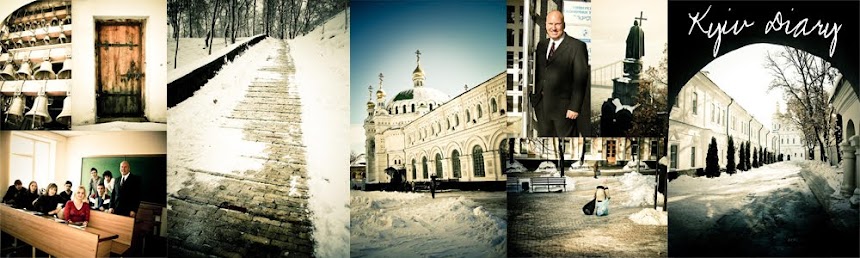
Showing posts with label Dnipro River. Show all posts

Friday, November 23, 2007

Taking Leave of Kyiv


The Dnipro rolls on far below me, under the winter skies,
River barges moving suspended, detached on the waters,
And the wheeling birds in their winter flight, hovering over the trees,
The trees bowing over the majestic snows of Kyiv.
Around and over the river swarm you thousands,
And tens of thousands, people of the City, buying, selling, returning home,
Moving in countless conveyances on land and water,
The screeching of your wheels and blare of warning horns,
And vehicles above and below the earth, ever moving,
Ever breathing in and out with the passage of people.
I descend with you, I ascend with you,
The endless conveyors of the people, the stream of bundled figures,
I see you, each one, the secrets of your eyes and faces,
The history of your wanderings and toils,


The imprint of the village and farm, the survivors of Tsars and Tyrants,
The imprint of the West, the imitation of foreign trends and traits,
The careless pride in your boots, your bells, your sashes, your furs,
The hopes of young eyes, the memories of the old, the peace and serenity of your spirits.
Close now in my thoughts, you people of Kyiv, wending your way home, over the silvery streets, Walking now in bundled figures,
In companionable and silent throngs beneath the golden domes, the sky-blue walls,
Walking through your City, with the churches of the saints strung like pearls on a silver string,
City of a thousand churches, with all the bells ringing,
The sunlight gleaming from your onioned domes.
City of an ancient fame, City of an ancient name,
Your heroes fixed in bronze, the snow bowing down their shoulders,
The icicles run from elbows and beards.
City of Sorrow, of the prison doors, the starving millions, the fearsome pollutions,
City of death and life, of prison doors closed and then flung wide.
City and nation at the crossroads, at the junction of languages, tongues and people,
Gateway of Europe, highway of Asia, headwaters of the Black Sea and Mediterranean,
The cradle of culture, the prisoner of Empire,
And now, finally now, you City of the past, present and future, your free banners flowing, ,
City of lights, of endless passage, of learning, of love and of hope, I take my leave of you,
City of the Great Gate, long sealed and barred, now swinging wide.


Daniel Bay Gibbons
Kyiv, Ukraine
Friday, November 23, 2007

A Final Walk Through Kyiv


Though it is a cold and overcast day, I left the apartment at mid day (after packing) and took a final ride on the Metro and a walk through the streets of Kyiv. I rode the Funicular, saw St. Michael's, walked past St. Sophia's, visited St. Andrew's, browsed on the Andriysky Spusk, and ended up in my gazebo on the promontory overlooking the Dnipro. From there I said my goodbyes to this great and ancient City, and took my leave.

"Is There a Light For Me?"


Over the past several days I have been dipping into my new copy of Shevchenko's "Kobzar" (which means, "The Bard" in Ukrainian). I attempted to work out the meaning of several of his little poems. The first few lines of this one, entitled "Сестрі" with a date of July 20, 1859, appealed to me:


Минаючи убогі села
Понаддніпрянські невеселі,
Я думав: «Де ж я прихилюсь?
І де подінуся на світі?»


(In my edition of "Kobzar," this appears at page 642) My rough attempt at translation (with vast textual liberties taken) is as follows:

Passing Dnipro's towns and streets,
Of leafless trees and pavements gray,
I thought: "Is there a light for me
Above some porch along the way?"


This seems to capture the deepest longing of the human heart--to belong somewhere, to have a refuge from the night, to see welcoming faces peering through the evening windows, yellow with light. This sentiment has come to mind again and again over the past few days, as I have seen men on crutches asleep in the portals of the Metro, old women sitting hunched on street corners with little paper cups, begging for a few small coins, or long lines of plain-looking men and women selling home-grown beets, potatoes, cabbages, nuts or home preserves on busy sidewalks. It touches your heart to see those who are lost, alone, frightened or struggling to survive in this cold and wintry world.
.
In some small way, my efforts of the past few weeks have been to light a lamp above some little front porch by the wayside--to assist in kindling the light of freedom and liberty among a people who for too long have been subjected to fear and darkness. May the porchlights of this great nation burn ever bright.

Thursday, November 22, 2007

The Funicular in Action

Its Fun, Funny, even Funky. The Funicular is a unique nineteenth century trolley system that runs from the Poshtovo Ploscha Metro Station (which is almost at elevation of the Dnipro River) up the steep wooded hillside to the top of the Volodymyrska Hill Park. It is one of my favorite attractions in Kyiv, as it evokes the period of late Tsarist Rule of the late nineteenth and early twentieth century. There are two cars, each suspended from a huge steel cable, like counterweights on a grandfather's clock. Thus when one car ascends from the riverside station, the companion car at the top of the hill begins a smooth descent. The cars are both custom constructed at a nunique angle so that the passengers in each of the compartments are always sitting or standing upright. The ride is very smooth and very quiet, hardly disturbing the birds sitting on the boughs of the surrounding trees. In fact, one has this surreal sense of detachment, leaving the crowded Metro and the busy Kyiv sreet and then boarding the Funicular as if entering a separate peaceful world. So far I have ridden the Funicular six times, as it is a very convenient way for me to get either to the Volodymrska Hill Park, to the Monument to Prince Volodymyr the Great (the "Baptizer"), to St. Michael's of the Golden Domes, or to the Andriysky Spusk.

Saturday, November 17, 2007

Park of "Eternal Glory"


Coming out into the vast green spaces lining the Dnipro River north of Pechersk Lavra, one comes upon Vichnoyi Slavi Park, or the Park of "Eternal Glory." Dedicated to the fallen of World War II, it has an impressive granite obelisk as the focal center of several long walkways. These looked very beautiful in the early morning sunlight, glancing up off of the new fallen snow. Coming out onto the round plaza surrounding the obelisk, I saw for the first time a wide (and clear weather) prospect of the Dnipro River and the rest of the City beyond. With this perspective, one sees how really big this city is, sprawling in all directions for dozens of miles. On a clear day this spot might provide the furthest possible perspective that this city affords.


After visiting Pechersk Lavra, I returned by the same way, and saw that the Vichnoyi Slavi Park was a popular gathering place for wedding parties and families with small children. While the little kids rode their sleds down the surrounding hills, newly married couples and their guests had pictures taken with their backs to the Dnipro. I suppose that on this, one of the most important days of their lives, they want the furthest possible perspective from which to launch forward together.

Friday, November 16, 2007

St. Michael's of the Golden Domes

I concluded my morning's pilgrimage to Volodymyrs'ka Hill with a visit to St. Michael's Monastery of the Golden Domes. Inside a walled complex are several monastic buildings, a soaring campanille or bell tower, the small and unadorned but very appealing Church of St. John the Theologian and the beautiful Cathedral of the Golden Domes. The walls of the Cathedral as well as the outer wall of the entire monastery are of a light blue with gold and white trim. The domes themselves are spectacular. There has been a heavy snowfall this morning, and I noted that several Orthodox priests, most very young were shoveling snow on the stone plaza's surrounding the Cathedral, with the help of a large group of young men. It was interesting to see the youth and physical vigor of these Priests, so unlike anything I have ever seen in any of the ancient Churches in America. For many years my family owned a mountain cabin in the Wasatch Mountains near a Catholic monastery, and my father would often take us to watch the Catholic mass and purchase honey in the little store run by the monks. I was always impressed that the monks were almost all old men, with no young men among them. Here, however, the priests that I have seen all appear to be young men in the prime of life. I visited a little store selling icons and books, where I bought a Ukrainian Orthodox New Testament. I later went inside the Cathedral, where I was immediately struck by the very pleasant odor of burning wax. This was from the myriad of lighted candles placed by worshipers before the various icons. I also noted how there are no seats at all in the Cathedral, only areas for standing facing an ornate and beautifully decorated screen with both bas-relief sculpture work and brilliant, detailed and highly realistic paintings. One of the chief subjects of the artwork in the Cathedral is St. Michael himself, depicted in various scriptural settings, including in battle--the Archistrategos--wielding a sword while mounted on a white horse and slaying a hideous dragon at his feet. The Archistrategos is more than angel--he leads the heavenly forces in slaying the adversary dragon--hence he is also a στρατηγός (strategos) in the Greek sense of the word, a general. So struck was I by this image of the Archistrategos that I actually purchased an icon from one of the monks in the Cathedral depicting Michael slaying the dragon. I was also very intrigued by the screen, which separates the public areas of the Cathedral from that which is the exclusive precinct of the Priests. This priestly region is large, as one can see over the top of the screen to the common ceiling. It brought to mind many thoughts and images from the Old Testament regarding the Temple of Solomon and its various discrete spaces, including spaces that were reserved only for what the Russian translation calls the Первосвященник (the "First Priest" or the "High Priest"), who entered beyond a barrier or screen into the most sacred precincts of the Temple to perform rites of Atonement or salvation, but then returned back through to bless and bring salvation to the people. I have been invited to participate in an Orthodox Mass early Sunday morning, at which time I may have additional insights. Outside the gates of the Monastery, in the shadow of the soaring Campanile, are two walls of striking murals, obviously new, depicting, among other things, the City of Kyiv and its religious history. I was very struck with one panel of this massive mural showing the Dnipro River the green hills of the City beyond, and overneath all a procession of angelic figures who are, as it were, watching out over the city with books, vessels, musical instruments and other objects in their hands.

The Monument to the Baptizer


The Monument to Prince Volodymyr the Great has drawn me for many reasons. It is, after all, one of the most recognizable images of Kyiv, standing stark, with an almost medieaval fierceness about it, over the broad waters of the Dnipro. It is also a kind of sole survivor--I understand it is the largest religious symbol left untouched by the Soviet authorities over seven decades of anti-religious rule. It is also a great Christian symbol, it having been erected in 1853 to commemorate the first Christian baptisms in the Dnipro river below this spot in the year 988 after Prince Volodymyr had himself converted. This event is depicted on the face of the statue in a bas-relief entitled, "Baptism of the Rus." Finally, the Southeast corner of this monument is the site of a special prayer uttered over the nation of Ukraine and the people of Kyiv by Boyd K. Packer on September 12, 1991. For these, and other reasons, this place is very special to me.

My Snowy Pilgrimage to Volodymyrs'ka Hill Park


This morning I left the apartment early, wanting to see the monument to Prince Volodymyr the Great on the wooded hill overlooking the Dnipro River. Among all the places that I had wanted visit in Kyiv, this was perhaps first on my list. I was initially discouraged as stepped outside, because of a bitterly cold wind and a steady snowfall, but decided to proceed. I took the Metro from Lva Tolstovo Ploshcha to Posthtovo Ploshcha, rode the Funicular up the hill and found myself in a quiet dream world. There were several inches of new snow on the ground and the Volodymyrs'ka Hill Park at the summit was utterly deserted. I spent an hour or so wandering alone down the long tree-lined avenues in the snow. The snow continued to fall and there was a great calm. From the hill I had wonderful views of the icy Dnipro far below, of St. Michael's Monastery of the Golden Domes through the trees, and of the great Monument to Prince Volodymyr the Great. I stood for a time on the promontory near a little covered pavilion overlooking the river. I had a powerful feeling steal over me that this was a very sacred place. For reasons that I cannot explain, this special visit on a snowy morning must stand as the highlight of my time in Kyiv.

Monday, November 12, 2007

Lunch with a Saint


After teaching at the Academy in the morning and having "tea" with the faculty at the law school, I was invited to share lunch with Olga in her book-crammed apartment in the very ecclectic and fascinating neighborhood in the vicinity of Zoloti Vorota and Volodymrska. She cooked me food which she had planted and harvested on her own land on the opposite side of the Dnipro River. We had a marvelous hot borscht, seasoned cauliflower stalks and parsley salad with braised veal. It tasted so good on a snowy day, especially knowing that the hands that cooked it had also planted and nurtured it on the land. The antique clock from her old family home ticked away above us as we ate and visited. Over lunch Olga told me much of her family and her fascinating life, dating back to the horrendous days of the German occupation of World War II, and through her family's deep Orthodox piety during the repressive times of the Soviet Union. Much of what she shared with with me is too sacred and personal to express in this setting, but she has had experiences of deep import, which I have recorded in my personal diary. As I took leave of her I had the impression that here is a true Saint if there ever was one.

Saturday, November 10, 2007

Navigating the Metro

It is now about 5:30 p.m. I had a wonderful day. I first decided that I needed to learn how to use the Metro system. I purchased a couple of little green plastic tokens at a cashier's station (they cost 50 kopiykas each, or half a griven). I deposited my token in the turnstile, then followed a vast throng of people and we descended into the entrance at Lva Tolstovo. Here you descend into a long escalator, perhaps several hundred feet long, into a cathedral like space with archways opening onto parallel tracks, one on each side. I noted that some of the ornate grillwork bore the year, "1960," so I am assuming that is when it was built or refurbished. There is also, embossed in the brick and cement work, colored signs showing the direction of travel, all of the succeeding stops, as well as connections down the line. The trains come rushing in every few minutes, pause probably twenty seconds, and then hurtle off down the tunnel. After observing the procedure for a few minutes, I ventured into the subway car headed for the Maidan station. There I disembarked, and found the connecting tunnel which leads to the sister station, Chreschatik, which is on a different line.

The connecting tunnel is amazing. It has a high arched ceiling, and the whole thing gradually rises, then falls again to the other station. The connecting tunnel must be considerably longer than a football field. It was here that I met my new friend, Valery, playing his accordian for passing change.

At Chreschatik, I again observed and studied the signs, then boarded an east bound train for Arsenalna, a station further east. It was here that I hoped to begin a walk down the Dnieper River to Pecherska Lavra. When I got to the surface, however, I found that it was now raining steadily. I paused in the square at Arsenalna long enough to watch a plainly dressed woman, wielding a very old-fashioned looking broom, sweeping a spot for her to display her fresh flowers. I also inspected the Arsenalna statue, which is a war memorial, noting both the remaining sickle and hammer imagery of the former Soviet Union, as well as the poignant flowers and bouquets recently laid there.

Deciding to go to Pecherska Lavra another day, I again descended into the Metro at Arsenalna. Here the depth of the train platform is amazing. There two very long escalators leading down, each of which was easily 3-400 feet.

I left the Metro at Chreschatik, and decided to look for "Arena City," where I understood a somewhat Western-like grocery store exists. I had in hand the handwritten notes from the family of one of the other judge instructors, giving directions. Their teenage daughter wrote the notes out and, not knowing any Russian or Ukrainian, had drawn a very nice picture of the Cyrillic words "Мандарин Плаза" ("Mandarin Plaza")and logo on the grocery store door. I soon became lost trying to navigate the streets of downtown Kyiv, but in my travels, I recognized the logo and words written by the judge's daughter, and so decided to buy groceries. I purchased a couple of loaves of bread, some butter, honey, milk, orange drink, cheese, oranges and cold cereal. Upon leaving Mandarin Plaza, I asked a uniformed security guard how to get to the Lva Tolstovo Metro stop. He told me that it was only one street away and showed me the direction. I was quite proud of myself for being able to converse enough to find my way. Incidentally, I must not look like a total American idiot here, because in my travels I had two different people stop me to ask for directions.